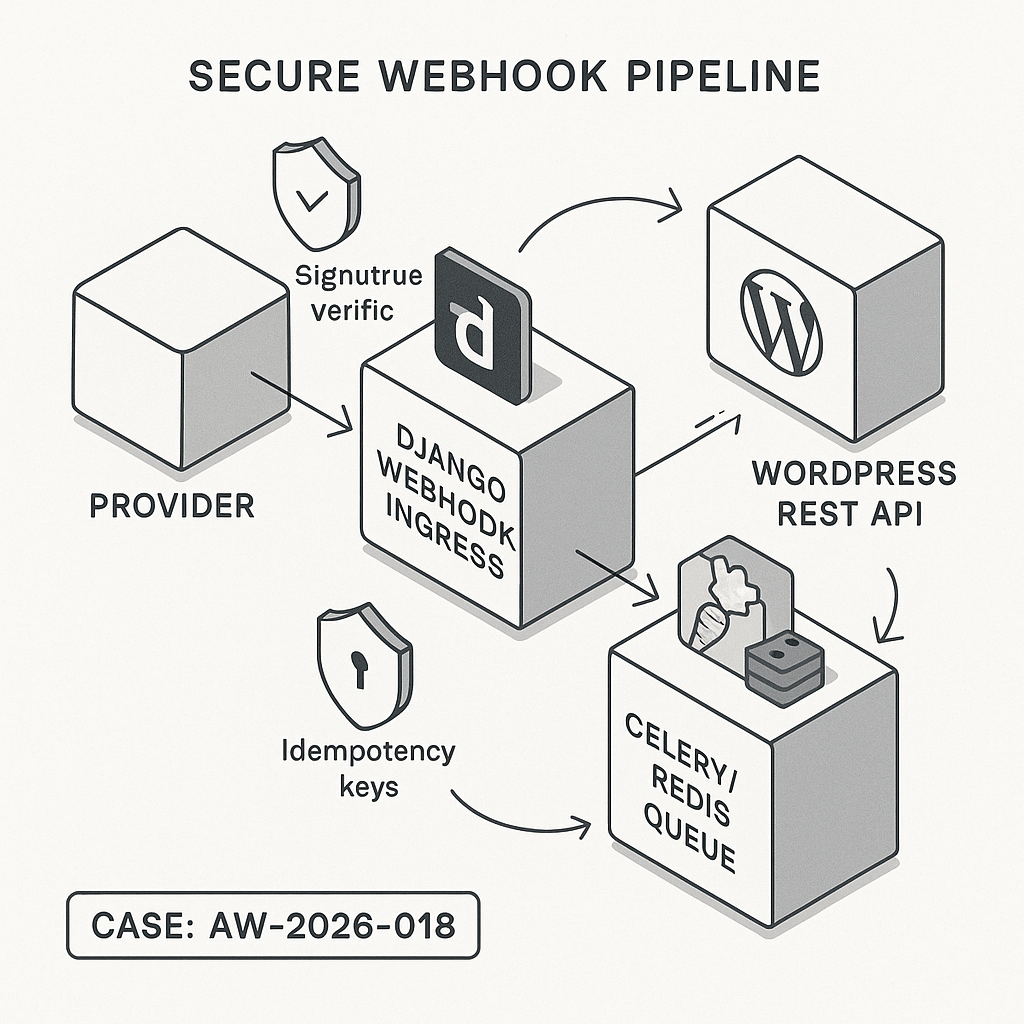
Why this pattern
– Webhooks arrive unpredictably, can burst, and must be authenticated.
– WordPress should not face the public webhook directly.
– Async processing ensures resilience, observability, and clean retry semantics.
Reference architecture
– External Provider → Django Webhook Ingress → Celery/Redis → Integrations → WordPress REST.
– Optional side writes: S3 for raw payloads, data warehouse, CRM.
– Control plane: secrets storage, circuit breaker, dead-letter queue (DLQ), observability.
Security controls
– Verify signatures (HMAC with timestamp).
– Return 202 quickly; push work to a queue.
– Enforce idempotency with a request hash and DB uniqueness.
– Store secrets in environment or a secret manager; rotate regularly.
– Restrict WordPress API with application passwords or JWT + IP allowlist.
– Log structured JSON without PII; hash IDs where possible.
Django: minimal webhook ingress
– Accept, verify, enqueue, 202. No heavy logic inline.
from django.views.decorators.csrf import csrf_exempt
from django.http import JsonResponse, HttpResponseBadRequest
from django.utils import timezone
import hmac, hashlib, json, base64, os, uuid
from celery import shared_task
from django.db import IntegrityError
from myapp.models import WebhookEvent # model with unique event_id
PROVIDER_SECRET = os.environ[“PROVIDER_WEBHOOK_SECRET”].encode()
def verify_signature(raw_body: bytes, signature: str, timestamp: str) -> bool:
# Provider-dependent. Example: base64(HMAC_SHA256(timestamp + “.” + body))
payload = f”{timestamp}.”.encode() + raw_body
mac = hmac.new(PROVIDER_SECRET, payload, hashlib.sha256).digest()
expected = base64.b64encode(mac).decode()
return hmac.compare_digest(expected, signature)
@csrf_exempt
def webhook_view(request):
if request.method != “POST”:
return HttpResponseBadRequest(“Invalid method”)
raw = request.body
sig = request.headers.get(“X-Provider-Signature”, “”)
ts = request.headers.get(“X-Provider-Timestamp”, “”)
if not (sig and ts) or not verify_signature(raw, sig, ts):
return HttpResponseBadRequest(“Bad signature”)
try:
payload = json.loads(raw.decode(“utf-8”))
except Exception:
return HttpResponseBadRequest(“Bad JSON”)
event_id = payload.get(“id”) or str(uuid.uuid4())
try:
WebhookEvent.objects.create(
event_id=event_id, # unique in DB
received_at=timezone.now(),
payload=payload,
status=”queued”,
)
except IntegrityError:
return JsonResponse({“status”: “duplicate”}, status=200)
process_webhook.delay(event_id)
return JsonResponse({“status”: “accepted”}, status=202)
Celery task: transform and deliver to WordPress
– Retries with exponential backoff.
– Circuit breaker via env flag to pause downstream calls.
import os, requests, time
from celery import shared_task
from django.conf import settings
from myapp.models import WebhookEvent
WP_API_BASE = os.environ[“WP_API_BASE”] # https://site.com/wp-json
WP_USER = os.environ[“WP_USER”]
WP_APP_PASS = os.environ[“WP_APP_PASS”] # WordPress Application Password
def wp_auth():
from requests.auth import HTTPBasicAuth
return HTTPBasicAuth(WP_USER, WP_APP_PASS)
@shared_task(bind=True, autoretry_for=(requests.RequestException,), retry_backoff=5, retry_kwargs={“max_retries”: 5})
def process_webhook(self, event_id: str):
ev = WebhookEvent.objects.get(event_id=event_id)
if ev.status in (“processed”, “skipped”):
return
payload = ev.payload
# Example transform
record = {
“source”: “provider_x”,
“external_id”: payload[“id”],
“status”: payload.get(“status”),
“summary”: payload.get(“summary”, “”)[:2000],
“metadata”: payload.get(“metadata”, {}),
}
if os.environ.get(“PAUSE_WP_DELIVERY”) == “1”:
ev.status = “held”
ev.save(update_fields=[“status”])
return
# Idempotent upsert into WordPress by external_id
r = requests.post(
f”{WP_API_BASE}/ai-guy/v1/ingest”,
json=record,
auth=wp_auth(),
timeout=10,
headers={“Idempotency-Key”: ev.event_id},
)
if r.status_code in (200, 201):
ev.status = “processed”
ev.downstream_response = r.text[:4000]
ev.save(update_fields=[“status”, “downstream_response”])
elif r.status_code in (409, 429, 503):
raise requests.RequestException(f”retryable {r.status_code}”)
else:
ev.status = “failed”
ev.downstream_response = r.text[:4000]
ev.save(update_fields=[“status”, “downstream_response”])
# Optional: send to DLQ or alert
Django model (compact)
from django.db import models
class WebhookEvent(models.Model):
event_id = models.CharField(max_length=128, unique=True, db_index=True)
received_at = models.DateTimeField()
status = models.CharField(max_length=16, db_index=True)
payload = models.JSONField()
downstream_response = models.TextField(blank=True, default=””)
WordPress: create a safe REST endpoint
– Use custom namespace and application passwords.
– Validate, sanitize, and upsert by external_id.
– Keep it fast. No remote calls inside this handler.
add_action(‘rest_api_init’, function () {
register_rest_route(‘ai-guy/v1’, ‘/ingest’, array(
‘methods’ => ‘POST’,
‘callback’ => ‘aiguy_ingest’,
‘permission_callback’ => function($request){
return current_user_can(‘edit_posts’);
},
‘args’ => array(
‘external_id’ => array(‘required’ => true, ‘type’ => ‘string’),
‘status’ => array(‘required’ => false, ‘type’ => ‘string’),
‘summary’ => array(‘required’ => false, ‘type’ => ‘string’),
‘metadata’ => array(‘required’ => false, ‘type’ => ‘object’),
),
));
});
function aiguy_ingest(WP_REST_Request $req) {
$ext_id = sanitize_text_field($req->get_param(‘external_id’));
$summary = wp_kses_post($req->get_param(‘summary’) ?: ”);
$status = sanitize_text_field($req->get_param(‘status’) ?: ‘new’);
$meta = $req->get_param(‘metadata’) ?: array();
// Idempotency via external_id + meta key
$existing = get_posts(array(
‘post_type’ => ‘ai_event’,
‘meta_key’ => ‘external_id’,
‘meta_value’ => $ext_id,
‘posts_per_page’ => 1,
‘fields’ => ‘ids’,
));
if ($existing) {
$post_id = $existing[0];
update_post_meta($post_id, ‘status’, $status);
update_post_meta($post_id, ‘metadata’, wp_json_encode($meta, JSON_UNESCAPED_SLASHES));
wp_update_post(array(‘ID’ => $post_id, ‘post_excerpt’ => wp_trim_words($summary, 55)));
return new WP_REST_Response(array(‘updated’ => $post_id), 200);
}
$post_id = wp_insert_post(array(
‘post_type’ => ‘ai_event’,
‘post_title’ => ‘AI Event ‘ . $ext_id,
‘post_status’ => ‘publish’,
‘post_content’ => ”,
‘post_excerpt’ => wp_trim_words($summary, 55),
));
if (is_wp_error($post_id)) {
return new WP_Error(‘insert_failed’, ‘Could not create post’, array(‘status’ => 500));
}
add_post_meta($post_id, ‘external_id’, $ext_id, true);
add_post_meta($post_id, ‘status’, $status, true);
add_post_meta($post_id, ‘metadata’, wp_json_encode($meta, JSON_UNESCAPED_SLASHES), true);
return new WP_REST_Response(array(‘created’ => $post_id), 201);
}
WordPress hardening
– Create a custom post type ai_event with limited capabilities.
– Restrict route with application passwords assigned to a dedicated low-privilege user.
– Optionally check Idempotency-Key header to reject duplicates quickly.
– Add rate limiting via a small transient-based token bucket if needed.
Operational playbook
– Local dev: use ngrok for Django endpoint; record/replay with stored JSON.
– Monitoring: structured logs including request_id, event_id, duration, status. Export Celery metrics and 5xx, latency, queue depth.
– Backpressure: scale Celery workers; use Redis priority queues; set max concurrency for WordPress deliveries.
– Data durability: persist raw payloads to S3 before processing for replays.
– Failure handling: 5xx/429 cause Celery retries; after max, send to DLQ table and alert Slack.
Performance tips
– Keep webhook handler under 50 ms by deferring all heavy work.
– Enable GZIP and HTTP keep-alive; set connection pool in requests.
– Batch WordPress updates when possible; or use a single custom table if volume is high.
– Add DB indexes on event_id and post meta keys; consider a dedicated ingestion table for constant-time lookups.
Configuration checklist
– Provider secret set in Django; WordPress app password created and scoped.
– Redis + Celery configured with visibility timeout > max task runtime.
– HTTPS everywhere; Django CSRF exempt only for the webhook route.
– Regular key rotation and secret scanning enabled in CI.
What you get
– A safe, observable, and scalable webhook fabric from AI providers into WordPress.
– Clear separation of concerns: ingress, processing, and delivery.
– Production defaults: verification, idempotency, retries, and minimal blast radius.

This is a very solid and scalable pattern; decoupling the public-facing ingress from WordPress is a critical security measure. For the ingress component itself, have you experimented with a serverless approach like AWS Lambda or Cloud Functions?
Good question — serverless can work really well for the ingress, especially when bursty traffic is the main concern. The big tradeoffs I’ve seen are around signature/auth verification (you still need careful timestamp/nonce handling), cold starts (can bite strict provider timeouts), and retries/idempotency (provider retries + platform retries means you want a clear dedupe key and a DLQ path). Observability can be better or worse depending on how you wire tracing/log correlation, and VPC/networking constraints (private Redis/DB, egress IP allowlists) can add latency/complexity compared to a Django service sitting “near” its queue and data store.
What webhook volume/burst profile are you expecting, and which provider(s) + their timeout/retry behavior (e.g., must respond <3s vs <10s)?
That’s a fantastic summary of the tradeoffs; I was thinking of a high-volume but infrequent burst profile where the provider’s generous retry policy made the serverless approach a good fit.
That bursty-but-spiky profile is where Lambda/Functions can shine, especially if the provider will patiently retry while you drain a queue. Do you know the provider’s required response window and whether their retries are strictly ordered (or can arrive out of order / concurrently)? Also, do you have any downstream dependency that’s sensitive to ordering (e.g., per-user/thread state updates in WordPress or a single “latest status” record)?
As a pragmatic next step, I’d aim to return 202 fast from the function and immediately enqueue (SQS/PubSub) with a DLQ, using a strong idempotency key (provider event ID + timestamp/signature hash) so provider retries and platform retries collapse cleanly. That keeps the ingress thin while preserving the same security and retry semantics you outlined.
Thank you, that is a very helpful and pragmatic approach; I will need to investigate the provider’s response window and retry ordering as you suggested.