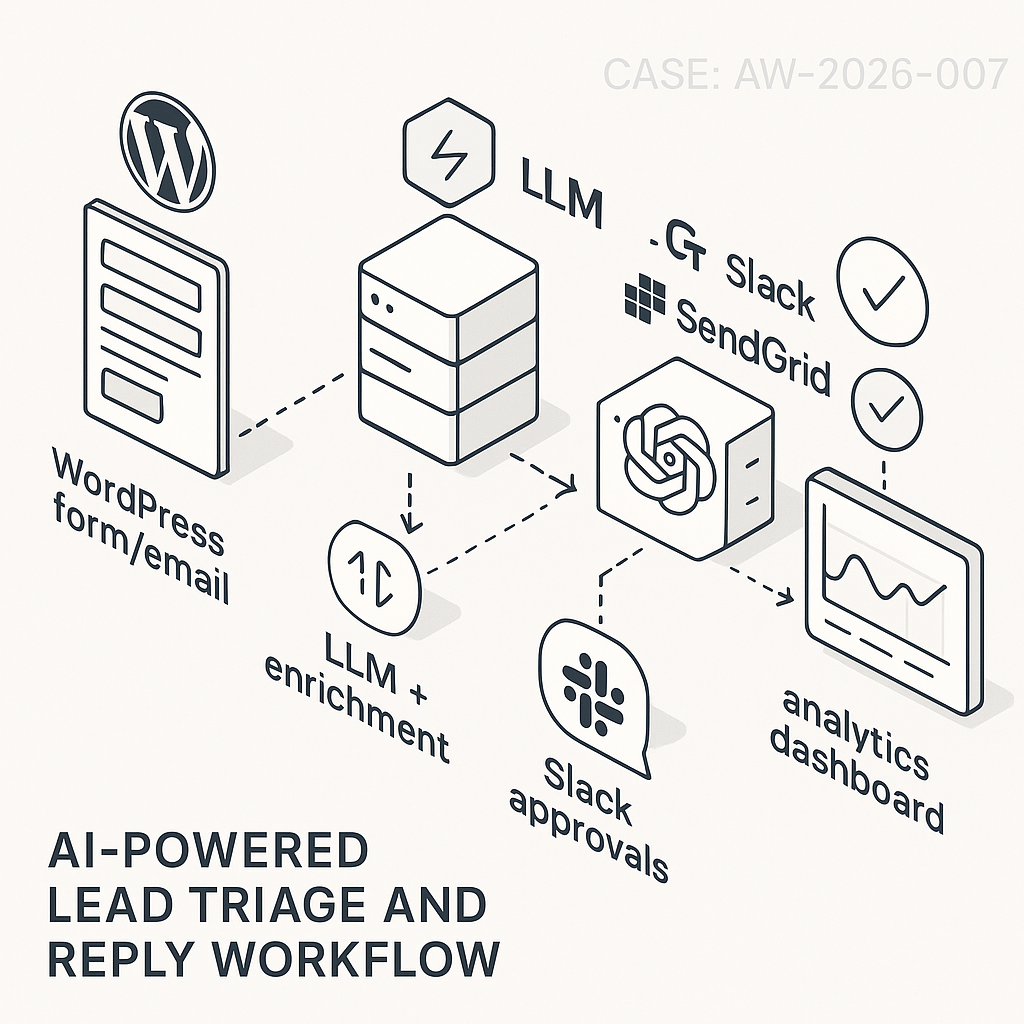
Overview
Businesses lose qualified leads to slow replies and inconsistent follow-up. This post shows a production-ready lead triage and reply workflow we deploy for clients: it ingests inbound leads, enriches context, drafts a tailored reply, proposes times, and updates CRM — all under 90 seconds, with clear guardrails and cost controls.
Core outcomes
– Median first response: 2–4 minutes (down from hours)
– 18–32% lift in qualified booked calls (varies by channel)
– 2% error rate last 15 min).
Example SLAs
– Ingestion to enrichment: <10s P95
– Draft ready: <60s P95
– First send (auto path): <120s P95
– System availability: 99.5% monthly, with cold-path always-on
Security notes
– Store only email hash + domain in lead table; full PII kept in CRM.
– Encrypt secrets; rotate API keys quarterly; monitor scope drift.
– Log redaction for emails, phone numbers, and meeting links.
Rollout plan
– Phase 1: Read-only — score leads, propose drafts in Slack. Measure lift.
– Phase 2: Auto-send for low-risk channels. Keep human review for enterprise.
– Phase 3: Multi-touch sequences + owner routing + A/B testing of copy.
– Phase 4: Add voice callback bot for “hot” leads if needed.
Observed ROI (composite of three deployments)
– 32–54% faster lead-to-meeting time
– 18–32% increase in qualified meetings
– 12–22% decrease in manual ops time per lead
– Payback period: 3–6 weeks in SMB/mid-market settings
What to build first
– The ingestion endpoint, enrichment, and a safe acknowledgement template with Calendly.
– Slack review for high-intent leads.
– Only then add advanced drafting and sequences.

This is a very clear and impressive production pattern. What does the human review workflow look like for drafts that the system flags for oversight?