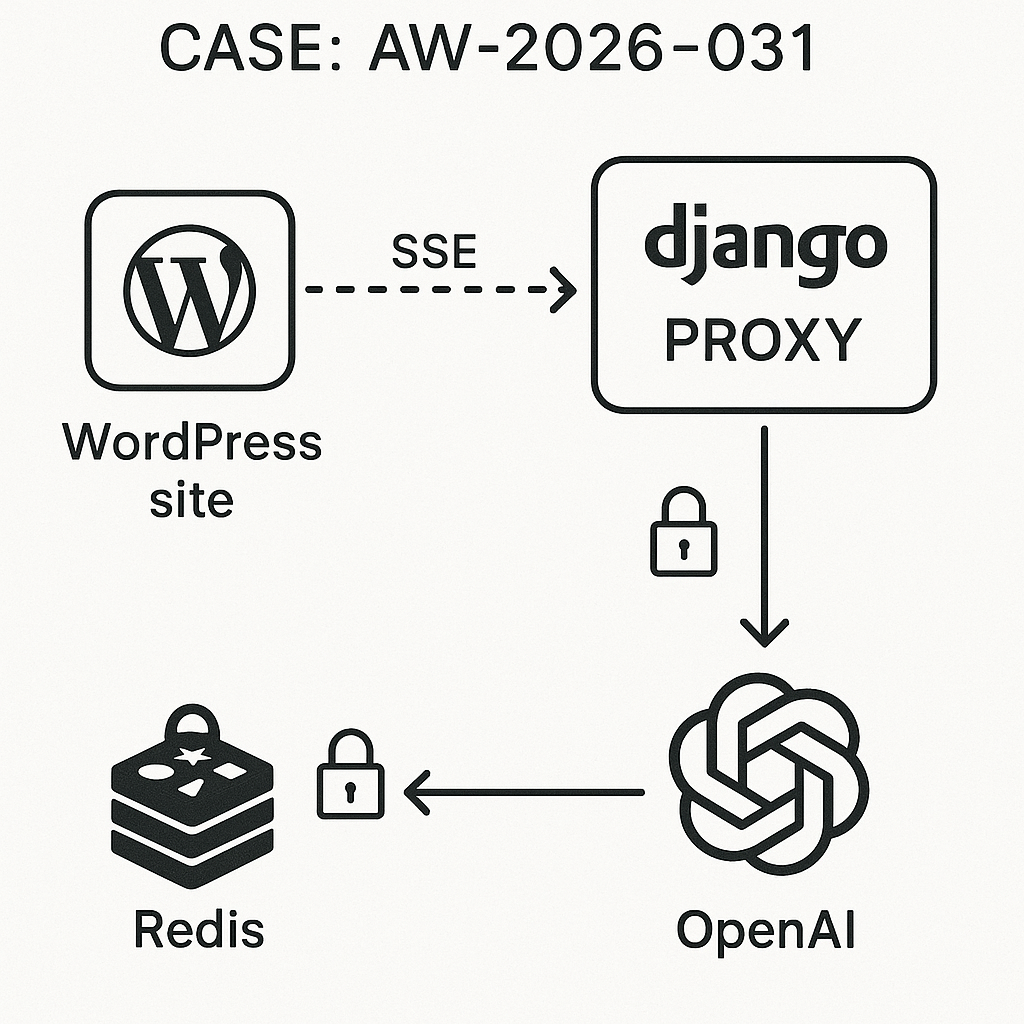
Why you need a proxy
– Keeps vendor keys off WordPress.
– Centralizes auth, rate limits, caching, and retries.
– Enables streaming and uniform observability across sites.
High-level architecture
– WordPress site(s) → Proxy (Django ASGI) → Provider APIs (OpenAI/Anthropic/etc.)
– Redis for rate limits, idempotency, and response cache.
– Postgres optional for audit logs.
– Cloudflare → NGINX → Uvicorn (Django ASGI).
Security model
– Per-site API key pair: site_id + site_secret (stored in WP).
– Request signature: HMAC-SHA256 over body + timestamp.
– JWT issued by proxy for short-lived sessions (optional).
– Nonce in WordPress UI, capability checks for settings.
– IP allowlist and user-agent tagging for WordPress clients.
– Enforce TLS end-to-end.
Django proxy (ASGI) essentials
– Django 5.x, Python 3.11+, Redis, httpx (async), uvicorn.
– Endpoints:
– POST /v1/chat (stream or non-stream)
– POST /v1/embeddings
– GET /v1/models (capability discovery)
– Headers:
– X-Site-ID, X-Timestamp, X-Signature, X-Client-Request-ID
Example models.py (optional audit)
from django.db import models
class InferenceLog(models.Model):
request_id = models.CharField(max_length=64, db_index=True)
site_id = models.CharField(max_length=64, db_index=True)
route = models.CharField(max_length=32)
prompt_hash = models.CharField(max_length=64, db_index=True)
provider = models.CharField(max_length=32)
tokens_in = models.IntegerField(default=0)
tokens_out = models.IntegerField(default=0)
status = models.IntegerField()
elapsed_ms = models.IntegerField()
created_at = models.DateTimeField(auto_now_add=True)
Rate limiting (Redis, sliding window)
– Key: rl:{site_id}:{route}
– Allow N requests per window, e.g., 60/min, 600/hour.
– Return 429 with Retry-After.
Pseudo-implementation (views.py, chat streaming)
import asyncio, hmac, hashlib, time, json, os
import httpx
from django.http import StreamingHttpResponse, JsonResponse
from django.views.decorators.csrf import csrf_exempt
from django.utils.crypto import constant_time_compare
import redis
r = redis.Redis.from_url(os.environ[“REDIS_URL”], decode_responses=False)
PROVIDER_KEY = os.environ[“PROVIDER_KEY”]
HMAC_SECRET = os.environ[“HMAC_SECRET”].encode()
def verify_sig(raw, ts, sig):
if abs(int(time.time()) – int(ts)) > 60:
return False
mac = hmac.new(HMAC_SECRET, raw + ts.encode(), hashlib.sha256).hexdigest()
return constant_time_compare(mac, sig)
def rl_allow(site_id, route, limit=60, window=60):
key = f”rl:{site_id}:{route}”
now = int(time.time())
pipe = r.pipeline()
pipe.zremrangebyscore(key, 0, now-window)
pipe.zadd(key, {str(now): now})
pipe.zcard(key)
pipe.expire(key, window)
_, _, count, _ = pipe.execute()
return count 3:
yield b”event: errorndata: {“message”:”upstream_failed”}nn”
break
await asyncio.sleep(backoff)
backoff *= 2
yield b”event: donendata: {}nn”
if stream:
return StreamingHttpResponse(gen(), content_type=”text/event-stream”)
else:
# Non-stream path
async with httpx.AsyncClient(timeout=60) as client:
resp = await client.post(
“https://api.openai.com/v1/chat/completions”,
headers={“Authorization”: f”Bearer {PROVIDER_KEY}”},
json={“model”: payload.get(“model”,”gpt-4o-mini”), “messages”: prompt}
)
data = resp.json()
r.setex(ck, 60, json.dumps(data))
return JsonResponse(data, status=resp.status_code)
NGINX (SSE buffering)
– proxy_buffering off;
– proxy_read_timeout 300s;
– add_header Cache-Control no-cache;
Gunicorn/Uvicorn
– uvicorn app.asgi:application –host 0.0.0.0 –port 8000 –workers 2 –loop uvloop –http h11
WordPress plugin (minimal)
– Stores Proxy Base URL, Site ID, Site Secret.
– Adds a shortcode [ai_chat] that renders a simple chat box.
– Uses SSE via EventSource to stream responses.
– Nonces for AJAX init; sanitize all options; only admins can edit.
Plugin main file (ai-proxy-chat/ai-proxy-chat.php)
‘POST’,
‘permission_callback’=>function(){ return wp_verify_nonce($_POST[‘_wpnonce’] ?? ”, ‘aig_sig’); },
‘callback’=>[$this,’sign’]
]);
});
}
public function menu() {
add_options_page(‘AI Proxy Chat’,’AI Proxy Chat’,’manage_options’,’aig-proxy-chat’,[$this,’settings’]);
}
public function register() {
register_setting(self::OPT, self::OPT, [‘sanitize_callback’=>[$this,’sanitize’]]);
add_settings_section(‘main’,’Settings’, ‘__return_false’,’aig-proxy-chat’);
add_settings_field(‘base_url’,’Proxy Base URL’,[$this,’field’],’aig-proxy-chat’,’main’,[‘k’=>’base_url’]);
add_settings_field(‘site_id’,’Site ID’,[$this,’field’],’aig-proxy-chat’,’main’,[‘k’=>’site_id’]);
add_settings_field(‘site_secret’,’Site Secret’,[$this,’field’],’aig-proxy-chat’,’main’,[‘k’=>’site_secret’]);
}
public function sanitize($v){
return [
‘base_url’=>esc_url_raw($v[‘base_url’] ?? ”),
‘site_id’=>sanitize_text_field($v[‘site_id’] ?? ”),
‘site_secret’=>sanitize_text_field($v[‘site_secret’] ?? ”)
];
}
public function field($args){
$o = get_option(self::OPT,[]);
$k = $args[‘k’];
$type = $k===’site_secret’ ? ‘password’ : ‘text’;
printf(”, $type, self::OPT, esc_attr($k), esc_attr($o[$k] ?? ”));
}
public function settings(){
echo ‘
AI Proxy Chat
‘;
settings_fields(self::OPT); do_settings_sections(‘aig-proxy-chat’); submit_button(); echo ‘
‘;
}
public function assets() {
wp_register_script(‘aig-chat’, plugins_url(‘chat.js’, __FILE__), [], ‘1.0’, true);
wp_localize_script(‘aig-chat’, ‘AIG_CHAT’, [
‘nonce’=>wp_create_nonce(‘aig_sig’),
‘sigEndpoint’=>rest_url(‘aig/v1/sig’)
]);
}
public function shortcode(){
wp_enqueue_script(‘aig-chat’);
ob_start(); ?>
get_param(‘body’) ?? ”;
$ts = time();
$sig = hash_hmac(‘sha256’, $body . $ts, $o[‘site_secret’] ?? ”);
return [‘ts’=>$ts,’sig’=>$sig,’site_id’=>$o[‘site_id’] ?? ”,’base_url’=>$o[‘base_url’] ?? ”];
}
}
new AIG_Proxy_Chat();
Client JS (ai-proxy-chat/chat.js)
(function(){
const log = (t)=>{ const el = document.getElementById(‘aig-log’); el.innerHTML += t + ‘
‘; el.scrollTop=el.scrollHeight; };
document.addEventListener(‘submit’, async (e)=>{
if(e.target.id !== ‘aig-form’) return;
e.preventDefault();
const input = document.getElementById(‘aig-input’);
const msg = input.value.trim(); if(!msg) return;
log(‘You: ‘+msg); input.value = ”;
const body = JSON.stringify({model:’gpt-4o-mini’, stream:true, messages:[{role:’user’,content:msg}]});
const sigRes = await fetch(AIG_CHAT.sigEndpoint, {method:’POST’, credentials:’same-origin’, headers:{‘Content-Type’:’application/x-www-form-urlencoded’}, body:new URLSearchParams({_wpnonce:AIG_CHAT.nonce, body})});
const {ts,sig,site_id,base_url} = await sigRes.json();
const url = base_url.replace(//+$/,”) + ‘/v1/chat’;
const es = new EventSourcePolyfill ? new EventSourcePolyfill(url, {
headers: {‘X-Site-ID’:site_id,’X-Timestamp’:String(ts),’X-Signature’:sig,’Content-Type’:’application/json’},
payload: body
}) : null;
if (es){
let acc = ”;
es.onmessage = (ev)=>{ try {
const d = JSON.parse(ev.data);
const delta = d.choices?.[0]?.delta?.content || d.choices?.[0]?.message?.content || ”;
if(delta){ acc += delta; }
if(delta) log(delta);
} catch(_){} };
es.addEventListener(‘done’, ()=>{ log(‘
‘); es.close(); });
es.addEventListener(‘error’, ()=>{ log(‘Stream error‘); es.close(); });
} else {
// Fallback: POST then append
const res = await fetch(url, {method:’POST’, headers:{‘X-Site-ID’:site_id,’X-Timestamp’:String(ts),’X-Signature’:sig,’Content-Type’:’application/json’}, body});
const data = await res.json();
const text = data.choices?.[0]?.message?.content || ‘[no content]’;
log(text); log(‘
‘);
}
}, true);
})();
Hardening checklist
– WordPress: escape output, sanitize options, restrict settings to manage_options, use nonces everywhere.
– Proxy: validate JSON schema, enforce token limits, redact PII in logs, cap request size (e.g., 256KB), timeouts + retries, 429/503 behavior.
– NGINX: limit_req by IP as outer guard; set client_max_body_size 512k.
– Redis: use ACLs and TLS; set maxmemory with allkeys-lru for cache eviction.
– Keys: rotate provider keys; per-site secrets; revoke on abuse.
– Observability: request_id header, structured JSON logs, latency and token metrics.
Performance notes
– Streaming path: TTFB ~80–150 ms via proxy; throughput limited by provider stream.
– Non-stream with cache: ~5–15 ms from Redis hit.
– Uvicorn workers scale horizontally; keep WordPress PHP-FPM unchanged.
When to extend
– Add /v1/embeddings with response cache and vector store indexing.
– Add model routing policy and quota per site.
– Add document upload pipeline (signed URLs, antivirus, OCR) before LLM.
