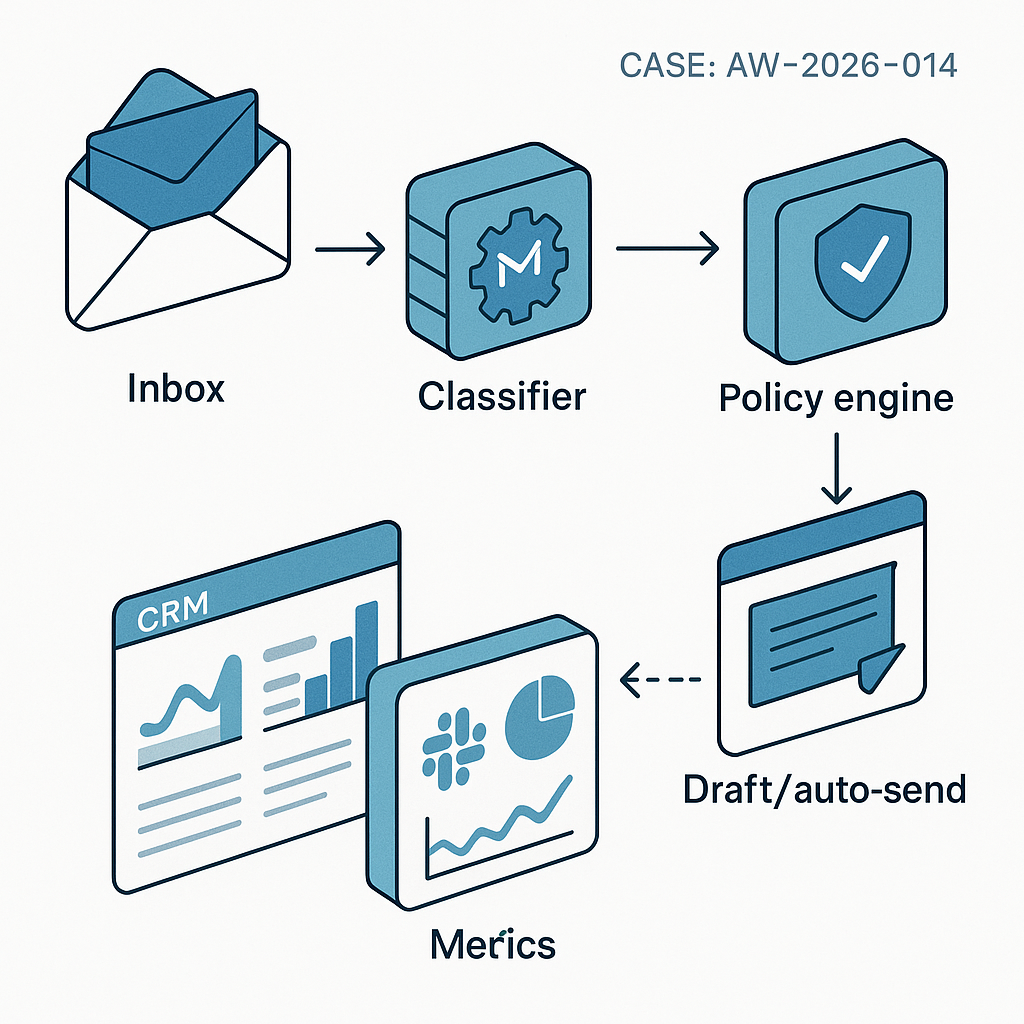
Problem
Support, sales, and ops inboxes drain time with repetitive triage and templated replies. Off-the-shelf “AI inbox” tools are opaque and hard to control. We want a system we can host, audit, and tune.
Outcome
A queue-driven service that:
– Classifies incoming emails by intent, urgency, and owner
– Auto-replies when safe, drafts replies when not
– Enriches contacts and logs everything to CRM
– Measures precision, latency, and savings
Core architecture
– Ingestion: Gmail/Google Workspace or Outlook webhook to Pub/Sub/SQS
– Processing service: Python (FastAPI) workers pull from queue
– Models: Hosted LLM (gpt-4o-mini or Claude Haiku) for NLU + drafting; small local model optional for lightweight classification
– Policy engine: JSON rules for sender allowlists, domains, SLAs, PII handling
– Templates: Jinja2 response library with slot-filling
– Human-in-the-loop: Drafts to Slack thread or Helpdesk (Zendesk/Help Scout) for one-click approve/edit/send
– Persistence: Postgres for message states; Redis for idempotency, rate limits
– Integrations: CRM (HubSpot/Pipedrive), Helpdesk, Slack, Calendar, Knowledge base
– Observability: OpenTelemetry traces; Prometheus metrics; S3/Blob for redacted samples
– Security: Service account with least privilege; KMS for secrets; structured redaction
Flow
1) New email hits webhook → normalized payload pushed to queue
2) Pre-filter: spam/auto-replies; dedupe via Redis
3) Classifier LLM (cheap, fast) → {intent, urgency, owner, policy_flags}
4) Router: apply policies and business rules
5) Response path:
– Safe and low-risk → template fill + LLM paraphrase → auto-send
– Medium risk → draft to Slack/Helpdesk with approve/edit buttons
– High risk or VIP → assign human, include suggested outline
6) Enrichment: look up contact, past tickets, open deals; light web/company data
7) Log action: CRM note, ticket updates, analytics counters
8) Post-send QA: spot-check sampling with a secondary model; tag issues
9) Feedback loop: human edits create fine-tuning examples for style and tone
Model selection
– Classifier: gpt-4o-mini or Claude Haiku for low cost/latency
– Drafting: gpt-4o-mini for most; higher-end model for complex replies
– Optional local: Llama 3.1 8B for intent tags if data residency requires
– Summaries for Slack: smallest viable model
Prompt design (concise)
System: You are an inbox triage assistant for {Company}. Output strict JSON only. Never invent facts or offers.
User: Email text + thread + CRM context + policies
Tools: Template library, company FAQ, product catalog
Guardrails:
– Allowed intents list
– No promises of discounts/SLA changes
– Redact PII before LLM calls when policy_flags include sensitive
Templates (examples)
– Scheduling: propose 2 time slots; include Calendly link if provided
– Pricing info: approved price sheet paragraphs only
– Support ack: ticket created, ETA window, links to docs
– Referral/partner: route to partnerships alias
Data model (Postgres)
– messages(id, thread_id, sender, subject, received_at, status, intent, urgency, owner, policy_flags, auto_sent boolean)
– drafts(id, message_id, draft_text, template_id, approver, decision, latency_ms)
– metrics(date, intent, auto_rate, approve_rate, revert_rate, avg_latency_ms, cost_usd)
Security and compliance
– OAuth with restricted scopes (read-only bodies + send mail); no full mailbox dumps
– Encrypt payloads in transit and at rest; KMS-managed keys
– Redact PII fields before external LLM calls when flagged
– Store minimal context; retain samples with redactions for 30–90 days only
– Audit log all auto-sends
Latency targets
– P50 triage < 1.2s, P95 < 3s
– Draft generation < 2.5s typical
– Slack approval path end-to-end < 60s
Cost model (typical SMB)
– 1,500 inbound emails/week
– 60% classified safe, 30% draft, 10% human from scratch
– With gpt-4o-mini:
– Classify pass: ~$0.0006/email
– Draft pass: ~$0.004–0.01/email
– Est. weekly spend: $12–$25
– Time saved: 6–12 hours/week per shared inbox
KPIs to track
– Auto-send precision (manual QC sample) ≥ 98% target
– Human correction rate on drafts enqueue(msg)
Worker:
msg = dequeue()
if is_spam(msg): return
features = redact(msg)
tags = llm_classify(features)
decision = route(tags, policies)
if decision.auto_send:
draft = fill_template(tags, kb, crm)
safe = lint(draft, policies)
send_email(safe)
log_metrics(…)
elif decision.needs_review:
draft = fill_template(…)
post_to_slack(draft, approve_url)
else:
assign_human(msg)
What makes this production-ready
– Queue-first for resilience and backpressure
– Clear policies over prompts; measurable thresholds
– Human control on medium/high-risk paths
– Observability by default
– Data minimization and redaction path
– Auditable outcomes tied to CRM and tickets
Where this works best
– High-volume inquiry inboxes (support@, info@, sales@)
– Teams with defined templates and policies
– Organizations needing auditability and cost control
Next steps
– Start in dry-run for one week to collect labels and tune
– Promote 1–2 intents to auto-send with strict thresholds
– Review weekly metrics; expand coverage as precision holds
