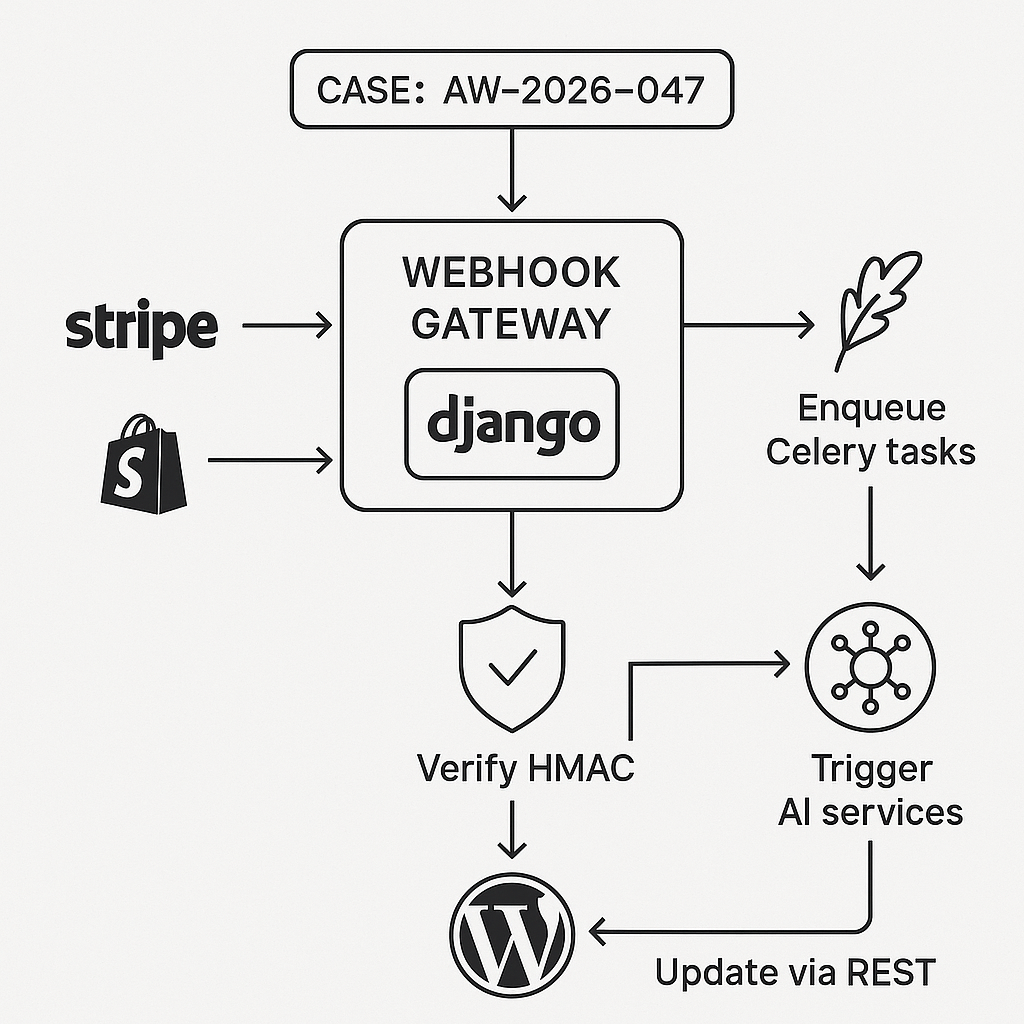
Why this matters
Webhook spikes, flaky networks, and duplicate deliveries can break AI automations. A dedicated gateway absorbs external events, validates and normalizes payloads, and reliably triggers downstream AI tasks—without blocking third‑party timeouts.
Reference architecture
– Sources: Stripe, Slack, HubSpot, Shopify, WordPress (outbound)
– Ingestion: Django REST API behind Nginx/Cloudflare
– Queue: Celery + Redis (or RabbitMQ)
– Storage: PostgreSQL (events, dedupe), S3-compatible blob storage (optional payload archive)
– Workers: Celery tasks for AI calls, CRM updates, email, etc.
– Destinations: WordPress REST API, CRMs, internal services
– Observability: Sentry, OpenTelemetry, structured logs, metrics
– Security: HMAC signature verification, JWT between services, IP allowlists, secrets rotation
Django models (idempotency + audit)
– WebhookEvent(id, source, event_type, signature_valid, idempotency_key unique, status [received|queued|processed|dead], received_at, processed_at)
– WebhookPayload(event fk, raw_json jsonb, headers jsonb, archive_url nullable)
– TaskResult(event fk, task_name, attempts, last_error, duration_ms)
Ingestion endpoint (Django REST Framework)
– Path: POST /api/hooks/{source}/
– Steps:
1) Read raw body bytes
2) Verify signature (per source)
3) Extract idempotency key (header or compute from body hash)
4) Insert WebhookEvent with unique constraint on idempotency_key
5) Persist payload (jsonb) and optionally stream to S3 if >256 KB
6) Enqueue Celery task with event_id
7) Return 200 quickly (<200 ms)
Example signature checks (Stripe + Shopify)
– Stripe: compute HMAC-SHA256 over “timestamp.body” using endpoint secret; enforce tolerance window
– Shopify: HMAC-SHA256 over raw body with shared secret; compare Base64-encoded signature
Django view (trimmed)
– Use raw_body = request.body, do not json.loads() before HMAC
– On IntegrityError for duplicate idempotency_key, return 200 to be idempotent
Example code (signature utils)
– Stripe:
– payload = raw_body.decode()
– signed = f"{timestamp}.{payload}"
– expected = hmac.new(secret, signed.encode(), hashlib.sha256).hexdigest()
– compare_digest(expected, provided)
– Shopify:
– expected = base64.b64encode(hmac.new(secret, raw_body, hashlib.sha256).digest()).decode()
Celery tasks pattern
– receive(event_id)
– fetch event + payload
– parse into typed schema (Pydantic/Django validators)
– route by event_type
– call AI services (e.g., OpenAI) with retries/backoff
– write TaskResult and update event.status
– push results to WordPress via REST
Retry and backoff
– Immediate ack to source; handle failures asynchronously
– Celery autoretry_for=(Exception,), retry_backoff=True, retry_jitter=True, max_retries=6
– Dead-letter: mark status=dead and notify (Slack/Sentry) after final failure
Idempotency enforcement
– Unique index on (source, idempotency_key)
– For sources without idempotency header: derive key = sha256(sorted_json) or sha256(raw_body)
– In tasks, guard side effects with get_or_create patterns and transactional outbox
Performance tips
– Do not perform AI calls in request thread
– Use ujson/orjson for parsing; keep raw bytes for HMAC
– Gzip and HTTP/2 via Nginx/Cloudflare
– Limit inbound payload size (e.g., 1–5 MB) and archive large bodies
– Batch low-priority events in workers when possible
Security checklist
– Verify signatures before touching business logic
– Enforce IP allowlists where providers publish ranges (Stripe, Shopify)
– Use short time windows for timestamped signatures (e.g., 5 minutes)
– Store secrets in env/secret manager; rotate regularly
– TLS everywhere; HSTS at edge
– JWT between WordPress and Django; scope tokens to minimal perms
WordPress integration (status + actions)
Use WordPress as the operations console and result sink.
– Authentication to WP:
– Use Application Passwords or JWT plugin over HTTPS
– Endpoints:
– POST /wp-json/ai-gateway/v1/events/{id}/status
– POST /wp-json/ai-gateway/v1/results
– Capabilities:
– Map to custom post type “ai_event” with meta: source, event_type, status, attempts, last_error
– Admin list table for filtering errors and replays
WP plugin sketch (server-to-server)
– Register REST routes
– Validate Authorization: Bearer
– Capability checks for write operations
– On result POST, update ai_event post meta and optionally create a visible log entry
Example flow: Stripe invoice.created -> AI summary -> WP note
1) Stripe hits /api/hooks/stripe with invoice payload
2) Gateway verifies signature and enqueues task
3) Worker extracts line items and generates a bullet summary with an LLM
4) Worker POSTs to WordPress:
– /wp-json/ai-gateway/v1/results with {event_id, customer, summary, url}
5) WP stores the summary as a private note or custom post; admins see statuses in wp-admin
Anti-duplication at destination
– Use WP post meta unique key “ai_event_id” to prevent duplicate inserts
– For updates, use PUT/PATCH with If-Unmodified-Since to avoid races
Observability
– Correlation IDs: request_id propagated from ingress -> Celery -> WP
– Structured logs (JSON) with source, event_type, event_id, attempt
– Metrics: ingress count, verify failures, queue depth, task duration, success rate
– Tracing: OpenTelemetry for Django + Celery; sample rate tuned for cost
Deployment notes
– Nginx -> Gunicorn (Django) with keepalive and proxy_read_timeout 10s
– Concurrency: start with 2–4 Gunicorn workers; Celery workers sized by CPU-bound vs I/O-bound tasks
– Health checks: /healthz for app, Redis ping, DB readiness
– Webhook timeouts: keep handler under 200 ms; return 2xx even if downstream queued
– Blue/green or rolling deploys; drain Celery queues before shutdown
Minimal Django snippets (illustrative only)
Model constraint:
– UniqueConstraint(fields=[“source”, “idempotency_key”], name=“uq_source_idem”)
Celery task decorator:
– @shared_task(bind=True, autoretry_for=(Exception,), retry_backoff=True, retry_jitter=True, max_retries=6)
Safe WordPress POST (Python):
– session.post(wp_url, json=payload, headers={“Authorization”: f“Bearer {jwt}”}, timeout=10)
Hardening and data hygiene
– Validate JSON against Pydantic schemas per source; drop unexpected fields
– Mask PII in logs; encrypt archives at rest
– Rate limit abusive sources via Nginx and DRF throttling
– Add a replay endpoint secured to admins: POST /api/hooks/replay/{event_id}
What to build first (phased plan)
– Phase 1: Single source (Stripe), signature verify, idempotency, queue, basic worker, WP result sink
– Phase 2: Multi-source router, observability, retries/backoff, dead-letter handling
– Phase 3: Admin console (WP), replay tooling, payload archiving, tracing
– Phase 4: Performance tuning, batching, multi-region failover
This gateway pattern keeps external SLAs happy while your AI automations stay reliable, secure, and observable.
