Goal
Add an AI assistant to WordPress that is fast, secure, and reliable under load. We’ll avoid long-running PHP, protect API keys, and support streaming. This is a production pattern we’ve deployed in client sites.
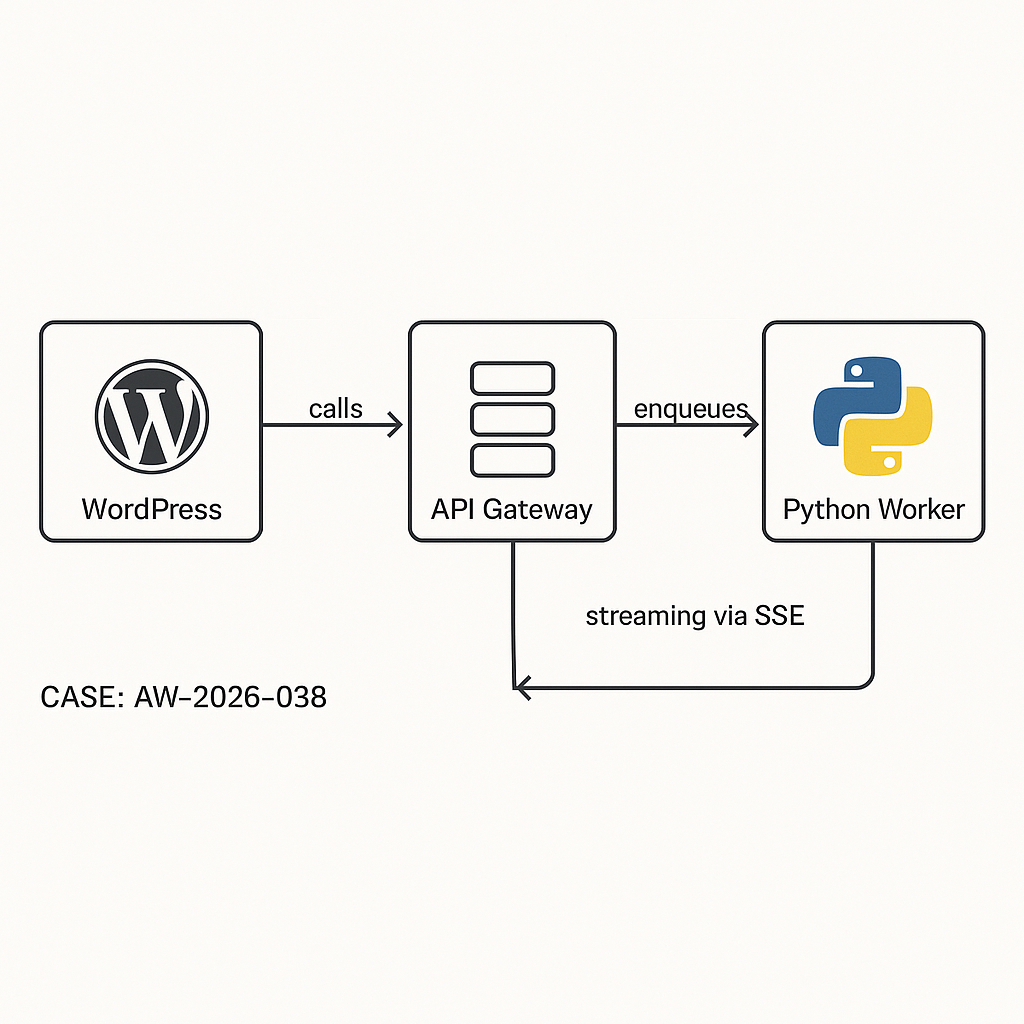
Architecture (high level)
– WP Plugin (PHP): UI + REST endpoints, stores minimal state, never holds LLM keys.
– API Gateway/Edge (Cloudflare/AWS): Auth, rate limiting, logging.
– Worker (Python/FastAPI): Orchestrates LLM calls (OpenAI/Azure/Anthropic), tools, retries; pushes results.
– Queue (Redis/SQS): Buffer workloads, smooth spikes.
– Storage: WordPress (postmeta/options) for user-visible data; object store/DB for logs.
– Optional Streaming: SSE via edge worker or reverse proxy, not from PHP-FPM.
Why this pattern
– Security: Keys never live in WP DB or theme code.
– Performance: No long PHP requests; async jobs run outside WordPress.
– Reliability: Queue + retries handle spikes/timeouts.
– Observability: Centralized logs/metrics for LLM latency and errors.
Data flow
1) Browser -> WP REST: user prompt + context (nonce + auth).
2) WP -> API Gateway: signed JWT; enqueue job.
3) Worker -> LLM/tools: executes, streams or finalizes.
4a) Streaming: Gateway proxies SSE to browser.
4b) Async: Worker posts result webhook back to WP; WP stores and notifies client via polling or webhooks.
Security hardening
– Cap checks: Only authenticated users, or signed public sessions with rate limits.
– Nonces for UI actions, WP REST permissions_callback.
– JWT from WP to gateway with short TTL; rotated HS256 secret in env, not DB.
– IP allowlist for worker->WP webhooks.
– Sanitize/escape all content rendered in WP.
– Log PII boundaries; redact before sending to LLM.
WordPress plugin skeleton (core pieces)
// Plugin header omitted for brevity
1) Settings (no LLM keys in WP):
– api_gateway_url
– jwt_issuer, jwt_kid
– public_rate_limit/window
– webhook_secret (HMAC shared with worker)
2) Admin settings + capability checks (manage_options).
3) REST routes:
– /ai/v1/chat (POST) -> enqueues
– /ai/v1/webhook (POST) -> receives results (IP + HMAC verified)
– /ai/v1/status (GET) -> poll job state (transients or custom table)
Minimal REST route example (enqueue)
“`
add_action(‘rest_api_init’, function() {
register_rest_route(‘ai/v1’, ‘/chat’, [
‘methods’ => ‘POST’,
‘callback’ => ‘ai_chat_enqueue’,
‘permission_callback’ => function($req){ return is_user_logged_in() || ai_allow_public(); }
]);
});
function ai_chat_enqueue(WP_REST_Request $req){
$prompt = wp_strip_all_tags($req->get_param(‘prompt’) ?? ”);
if (!$prompt) return new WP_Error(‘bad_request’, ‘Missing prompt’, [‘status’=>400]);
// Rate limit (user or IP)
if (!ai_rate_ok($req)) return new WP_Error(‘rate_limited’,’Try later’,[‘status’=>429]);
// Create job record (custom table or postmeta)
$job_id = ai_create_job([‘user_id’=>get_current_user_id(), ‘prompt’=>$prompt, ‘status’=>’queued’]);
// Sign JWT for gateway
$jwt = ai_sign_jwt([
‘iss’=>get_option(‘ai_jwt_issuer’),
‘sub’=> (string) get_current_user_id(),
‘jti’=> $job_id,
‘iat’=> time(),
‘exp’=> time()+60
]);
// Send to gateway
$resp = wp_remote_post(get_option(‘ai_gateway_url’).’/jobs’, [
‘timeout’=>5,
‘headers’=>[‘Authorization’=>”Bearer $jwt”, ‘Content-Type’=>’application/json’],
‘body’=> wp_json_encode([
‘job_id’=>$job_id,
‘prompt’=>$prompt,
‘context’=> ai_collect_context(),
‘webhook’=> home_url(‘/wp-json/ai/v1/webhook’)
])
]);
if (is_wp_error($resp) || wp_remote_retrieve_response_code($resp) >= 300) {
ai_update_job($job_id,[‘status’=>’error’,’error’=>’enqueue_failed’]);
return new WP_Error(‘upstream_error’,’Queue unavailable’,[‘status’=>502]);
}
return [‘job_id’=>$job_id, ‘status’=>’queued’];
}
“`
Webhook handler (worker -> WP)
“`
register_rest_route(‘ai/v1′,’/webhook’,[
‘methods’=>’POST’,
‘callback’=>’ai_webhook_handler’,
‘permission_callback’=>’__return_true’
]);
function ai_webhook_handler(WP_REST_Request $req){
// Verify HMAC and IP allowlist
if (!ai_verify_hmac($req)) return new WP_Error(‘forbidden’,’bad signature’,[‘status’=>403]);
$job_id = sanitize_text_field($req->get_param(‘job_id’));
$content = wp_kses_post($req->get_param(‘content’) ?? ”);
$usage = $req->get_param(‘usage’) ?? [];
ai_update_job($job_id, [‘status’=>’done’,’content’=>$content,’usage’=>$usage]);
// Optionally cache a hash of the prompt->response
set_transient(‘ai_job_’.$job_id, [‘status’=>’done’], 600);
return [‘ok’=>true];
}
“`
Frontend usage (enqueue + poll)
– Enqueue via wp.ajax or fetch to /wp-json/ai/v1/chat.
– Poll /status until done or use SSE channel if implemented at gateway.
– Render with esc_html or safe HTML subset.
Python worker (FastAPI outline)
– Validates JWT (issuer, exp, kid).
– Pushes to queue (Redis/SQS) with retry/backoff.
– Consumes jobs, calls LLM with tools/function-calls as needed.
– Optional SSE: Streams tokens through gateway to client.
– Posts final result to WP webhook with HMAC.
FastAPI snippets
“`
@app.post(“/jobs”)
def enqueue(job: Job, auth=Depends(verify_jwt)):
q.enqueue(job.dict())
return {“accepted”: True}
def process(job):
try:
resp = client.chat.completions.create(
model=os.getenv(“MODEL”),
messages=[{“role”:”user”,”content”: job[“prompt”]}],
timeout=30
)
content = resp.choices[0].message.content
usage = resp.usage.model_dump() if hasattr(resp,’usage’) else {}
post_webhook(job[“webhook”], job[“job_id”], content, usage)
except Exception as e:
post_webhook_error(job, str(e))
“`
Streaming via SSE (recommended)
– Don’t stream from PHP. Use edge worker that:
– Authenticates client cookie/session with a one-time token from WP.
– Opens SSE to Python worker that proxies LLM token stream.
– Applies per-user rate limits.
– WordPress only issues short-lived stream tokens; never touches LLM socket.
Rate limiting
– Per IP for anonymous, per user_id for logged-in.
– Server-side bucket at gateway (e.g., 30 requests/5m).
– UI throttle + backoff to avoid hammering.
Caching and cost control
– Cache deterministic prompts by normalized hash (strip whitespace, lowercased).
– Store minimal response + usage metrics for analytics.
– Deny-list high-cost paths; enforce max tokens and model allowlist at worker.
Observability
– Centralized logs with job_id correlation across WP, gateway, worker.
– Metrics: queue depth, LLM latency, error rate, token usage per user/site.
Database notes
– For scale, use a custom table ai_jobs (job_id PK, user_id, prompt_hash, status, content MEDIUMTEXT, usage JSON, created_at, updated_at).
– Index status, created_at for cleanup jobs.
– Cron: purge >30 days or anonymize prompt text.
Hardening checklist
– No LLM keys in WordPress DB or code.
– Short JWT TTL; rotate secrets; pin alg and kid.
– Webhook HMAC + IP allowlist.
– Escape output; sanitize HTML.
– Strict CORS only to site origin.
– Disable file edit in wp-config; limit plugin access.
When to choose what
– Small sites: WordPress + API Gateway + single worker (no queue) with short timeouts and SSE.
– Growing traffic: Add queue, retries, and circuit breakers.
– Enterprise: Multi-region gateway, KMS-managed secrets, private networking to WP origin.
Deliverables you can ship today
– WP plugin skeleton above + settings UI.
– FastAPI worker with JWT verify + enqueue + result postback.
– Cloudflare Worker for SSE proxy + rate limit.
– IaC to provision queue, logs, secrets.
