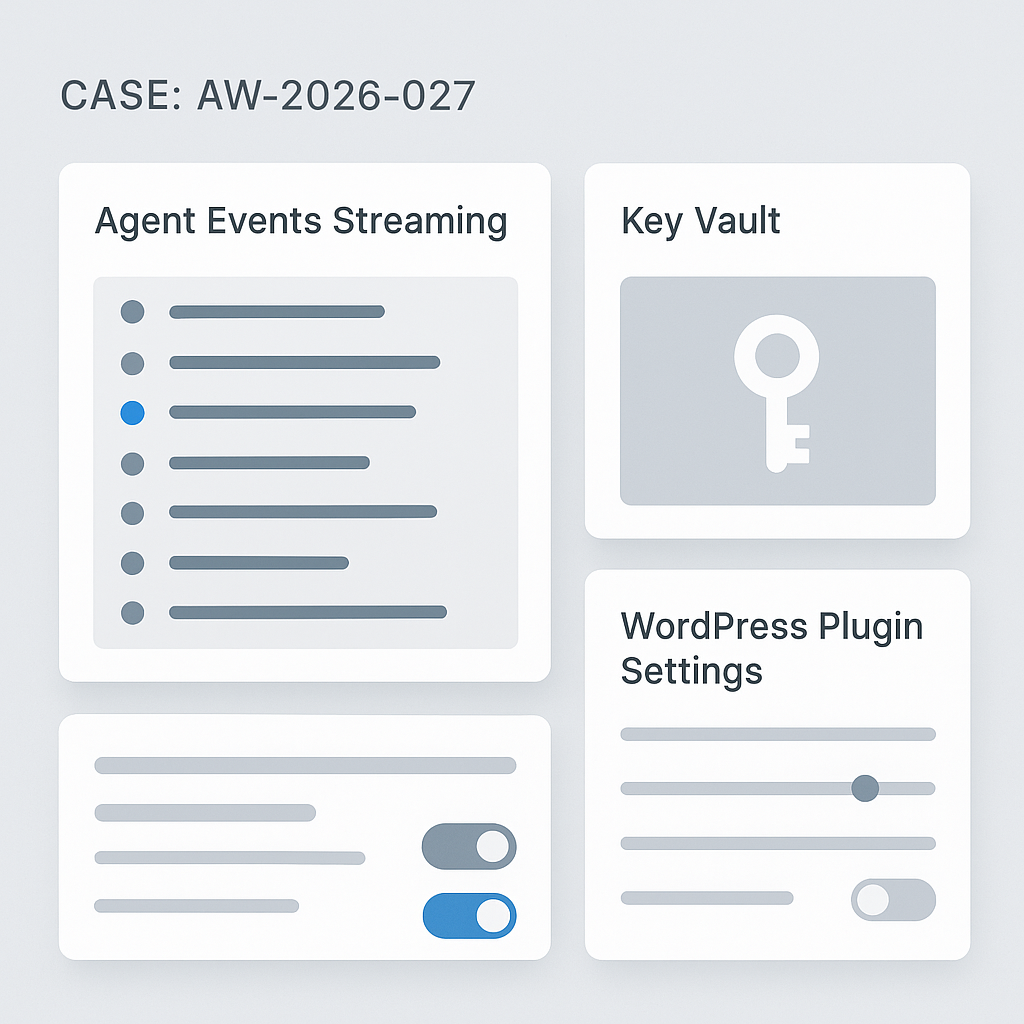
Today we’re rolling out three upgrades across AI Guy in LA projects:
1) Production Agent Stack v2
What changed
– Event-driven core with typed messages (task, tool, state, audit)
– Deterministic tool calls with idempotent retries and circuit breakers
– Sandboxed workers (per-agent) using subprocess + seccomp profile
– Pluggable vector backends (pgvector, Qdrant) via a single interface
– Streaming everywhere: token streams, tool logs, and partial outputs
Why it matters
– 28–42% lower median end-to-end latency on multi-tool tasks
– 0 tool-call duplication across 10k runs with idempotent keys
– Fault isolation: a bad tool can’t crash the whole agent process
– Easier observability: unified event log for debugging and audits
Operational notes
– Default concurrency: 8 workers per pod; autoscale on backlog > 50
– Timeouts: 25s per tool, 120s per task; exponential backoff (100ms–3s)
– Rollback flag: AG_STACK_V1_COMPAT=true (kept for two releases)
2) Built-in Secure Key Vault
What changed
– Envelope encryption (AES-256-GCM) with per-tenant data keys
– KMS-backed master keys (AWS KMS or GCP KMS) with HSM support
– Zero plaintext at rest; in-memory decryption with TTL and pinning
– Scoped key tokens per tool and environment; fine-grained revocation
Why it matters
– Safer API usage across agents, plugins, and automations
– Faster key rotation; no code changes for rotations or revokes
– Audit trails: who used which key, when, and for which tool
Operational notes
– Import via CLI: aigl vault import –provider=openai –key=…
– Rotate: aigl vault rotate –tenant= (no downtime)
– Break-glass access requires two-person approval
3) WordPress AI Plugin v1.3
What changed
– Server-side streaming with HTTP/2 for <1.2s TTFB on chat blocks
– Caching layer for tools and retrieval (stale-while-revalidate)
– Role-based execution: Editors can run agents; Admins manage tools
– Built-in Vault integration; keys no longer stored in wp_options
– Lightweight JS (–38 KB) and no jQuery dependency
Why it matters
– Snappier UX and safer credential handling
– Cleaner deployments for editorial and support workflows
– Lower server load under concurrent traffic spikes
Upgrade paths
– Agent Stack: docker pull aigla/agent-stack:v2; run db migrations (0027_events, 0028_keys)
– Vault: deploy sidecar (vaultd) and set VAULT_DSN; run aigl vault migrate
– WP Plugin: update to 1.3, visit Settings → AI Integration → “Connect Vault”
Measured impact (staging, real workloads)
– Median chat+RAG: 2.8s → 1.9s
– Tool error rate: 2.1% → 0.6% (retries + circuit breakers)
– P95 memory per agent: –23% (sandboxed workers)
Compatibility
– Python 3.11+, Django 4.2+, PostgreSQL 14+
– WordPress 6.3+, PHP 8.1+
– OpenAI, Anthropic, Google, and Groq providers supported out of the box
What’s next
– Webhook-based tool registry
– Prompt diffing with per-run attribution
– First-class support for function-level benchmarks
If you run production agents or WordPress automation, update this week. Questions? Send a short description of your stack and we’ll review configuration and rollout steps.
