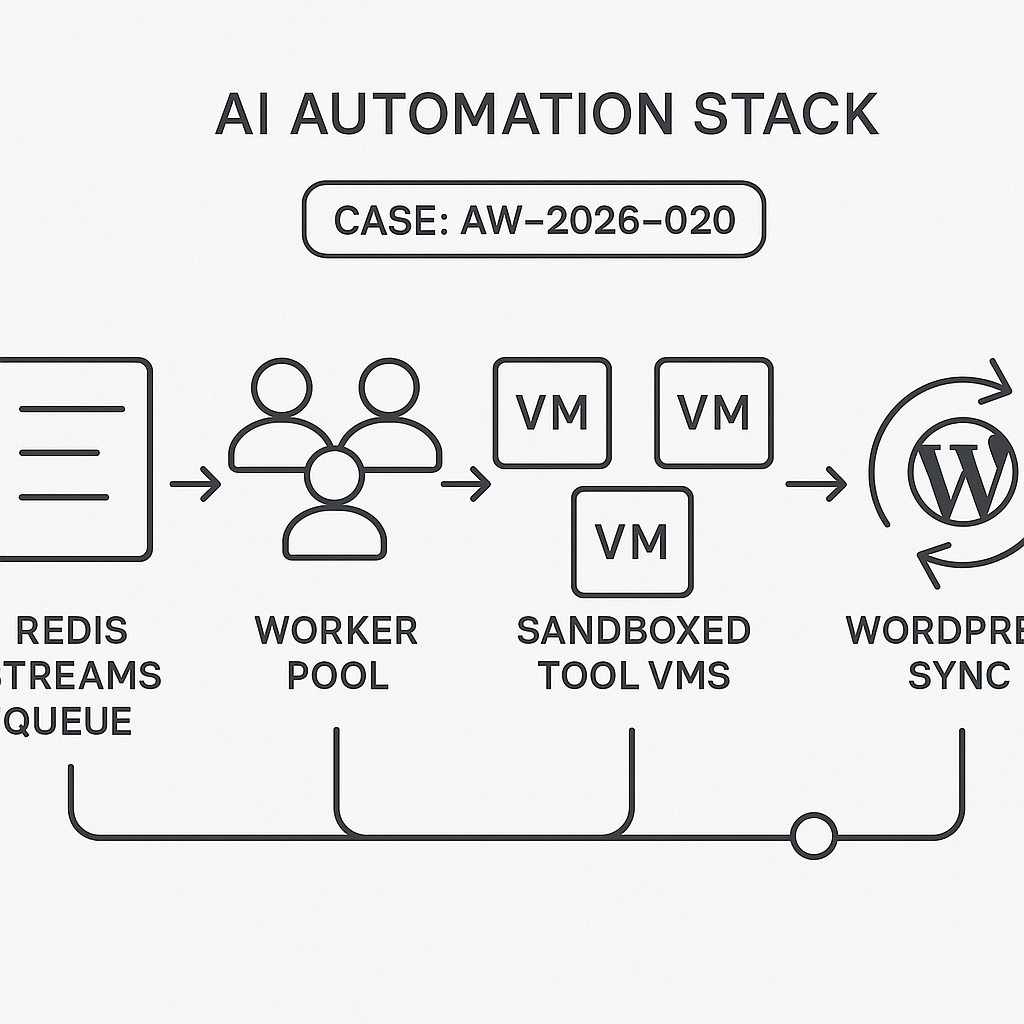
We’ve rolled out Production Agent Runner v0.6 across AI Guy in LA deployments. This release upgrades our orchestration, tool sandboxing, and observability for more reliable, auditable, and faster automation.
What’s new
– Orchestration: Migrated task pipeline to Redis Streams + Dramatiq with backpressure controls and idempotent message keys.
– Tool runtime: Sandboxed tool execution (Firecracker microVMs on Linux hosts) with per-call CPU/mem caps and kill-switch timeouts.
– Secrets: Per-tenant secrets vault with envelope encryption (AES‑GCM) and short‑lived tool-scoped tokens.
– Observability: End-to-end OpenTelemetry traces across Django API, workers, LLM calls, and third-party APIs; log-based SLOs.
– Adapters: Unified LLM provider layer (OpenAI, Anthropic, Google) with circuit breakers, retries, and cost tags.
– WordPress sync: Background content sync job with diff-based updates and rate-limit awareness.
Why it matters
– Lower latency under load and fewer stuck jobs.
– Safer execution for file, browser, and data tools.
– Faster root-cause analysis with trace context.
– Cleaner multi-tenant isolation and auditability.
Architecture notes
– Queueing: Redis Streams consumer groups; exactly-once semantics via dedup keys and “outbox” pattern in Django.
– Concurrency: Work-stealing worker pools; per-tenant concurrency ceilings to prevent noisy-neighbor effects.
– Retries: Exponential backoff with jitter; DLQ for hard failures; replay via admin task inspector.
– Sandboxing: Ephemeral microVM per tool run; read-only base image; write access only to temp mount; egress allowlist.
– Telemetry: Trace + span IDs propagate via W3C headers; logs correlated with trace_id for single-click drilldowns.
Performance impact (current production)
– p50 end-to-end task latency: -38%
– Failed runs due to timeouts: -62%
– Cold-start tool overhead (sandbox): +85–120 ms (acceptable for safety tradeoff)
Rollout and compatibility
– All active projects are on v0.6.
– No changes required for prompt or tool specs.
– API change: tool env variables must be requested via the secrets broker; direct env injection is blocked.
Migration notes for self-hosted clients
– Redis 7+ required. Enable lazyfree and set stream-max-len policies.
– Deploy OTel Collector sidecar; export OTLP to your APM of choice.
– Whitelist required egress domains if you run strict firewalls.
What’s next
– Tracing UI in the dashboard.
– Built-in prompt versioning with canary rollouts.
– Cost and token accounting per tenant and workflow.
Questions or need help migrating? Contact us with your deployment ID.

This is a fantastic update, particularly the move to Firecracker microVMs for sandboxed tool execution. Have you noticed any significant performance overhead with the new runtime?
Thanks, John — Firecracker is a big step up for isolation, but it can introduce some overhead depending on how often you’re cold-starting microVMs versus reusing warm ones. In practice, the main costs tend to show up as startup latency and a bit of added I/O overhead, while steady-state CPU can be quite close to native if the workload is long-running enough. Have you been tracking any before/after metrics like p95 tool-call latency, cold-start rate, and host CPU/memory utilization since the rollout?
Those are the exact metrics I was looking for, thank you—I haven’t gathered any before/after data yet but will start there.